
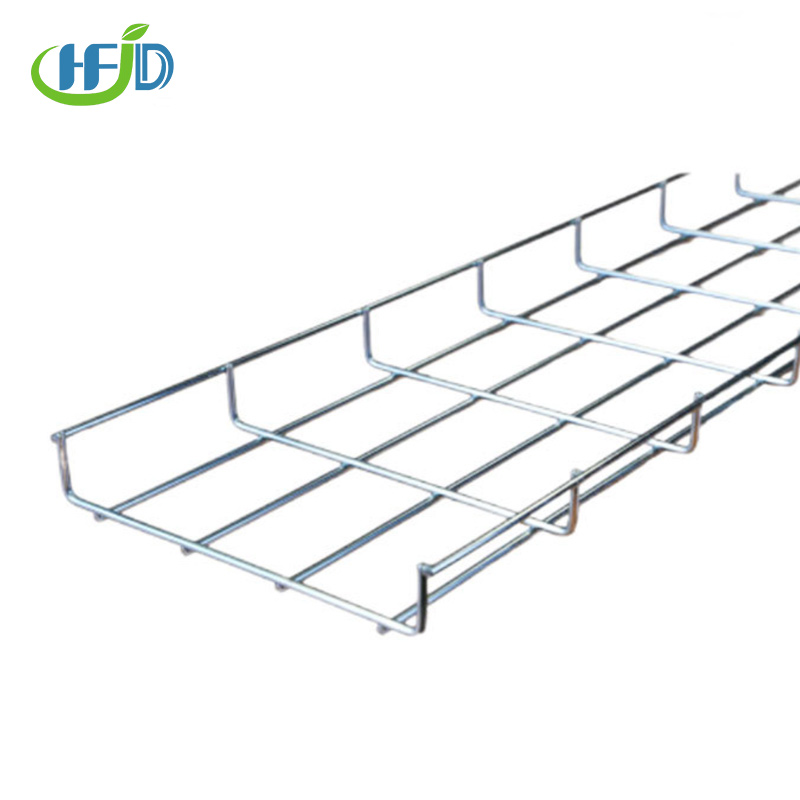
A wire mesh cable tray is an open cable management system made from welded metal wire. It is used to support and route power, control, data, communication, and other electrical cables while keeping them accessible for installation and maintenance.
Compared with enclosed cable management systems, wire mesh cable trays provide excellent ventilation, visibility, and flexibility. They are particularly useful in data centers, commercial buildings, industrial facilities, and electrical installations where cables may need to be added, moved, or inspected regularly.
But a wire mesh cable tray is not automatically the best choice for every project. The right solution depends on cable type, load, installation environment, required protection, and support design.
This guide explains how wire mesh cable trays work, where they are most suitable, what limitations to consider, and how to choose the right system.
Table of Contents
What Is a Wire Mesh Cable Tray?
A wire mesh cable tray, also called a wire basket cable tray, consists of welded steel wires formed into a tray structure. The open mesh design supports cables while leaving the sides and bottom accessible.
The structure typically includes horizontal and vertical wire sections that form a basket-like cable pathway. Cable tray accessories such as couplers, brackets, dividers, supports, and fixing clamps can be used to complete the installation.
The main purpose is simple: provide a secure, organized route for cables while making the cable system easy to access and maintain.
Unlike solid-bottom cable trays, a wire mesh design allows air to circulate around cables. It also makes it easier for installers to see and reach cables after installation.
How Does a Wire Mesh Cable Tray Work?
A wire mesh cable tray supports cables along a predefined route. The tray is installed on suitable supports, brackets, or other mounting structures, while cables are placed inside the tray.
Depending on the project, cables can be routed horizontally, vertically, or through changes in direction using suitable tray sections and accessories.
For example, a typical installation may include:
Cable tray → Coupler → Support bracket → Cable fixing accessory → Cable
The exact configuration depends on the building structure, cable load, routing requirements, and installation environment.
For vertical sections or locations where cable movement needs to be controlled, cable fixing clamps can provide additional restraint.

What Are the Main Advantages of Wire Mesh Cable Tray?
The open structure of a wire mesh cable tray provides several practical benefits.
Excellent Cable Accessibility
Installers can access cables from above and from the sides without removing a solid cover. This can make installation, inspection, and future cable changes more convenient.
This is especially useful in facilities where cable routes change over time.
Good Ventilation
The open mesh structure allows air to move around cables. This can help prevent heat from becoming trapped around cable bundles.
Thermal performance still depends on cable type, loading, installation spacing, ambient conditions, and engineering design, but the open construction provides a useful advantage for many cable management applications.
Easy Cable Identification
Because the tray is open, cables remain visible after installation. Maintenance personnel can more easily identify cable routes and inspect connections.
This can be valuable in data centers and industrial facilities where large numbers of cables may share the same route.
Flexible Cable Routing
Wire mesh cable trays can accommodate complex routing layouts when used with appropriate accessories. Sections can be connected and supported to create horizontal runs, vertical drops, bends, and transitions.
Convenient Installation
The relatively open structure makes cable placement and adjustment straightforward. Installers can add or reposition cables without working inside a completely enclosed channel.
When Should You Use a Wire Mesh Cable Tray?
A wire mesh cable tray is a strong option when accessibility, ventilation, and flexible cable routing are important project requirements.
Data Centers
Data centers often contain large quantities of network, fiber, power, and communication cables. These systems require organized routing while allowing technicians to inspect and modify cable paths.
The open construction of wire mesh cable trays makes them particularly suitable for areas where cable accessibility is a priority.
Commercial Buildings
Offices, shopping centers, hospitals, hotels, and other commercial buildings may require cable routes for electrical, communication, security, and data systems.
Wire mesh cable trays can provide an accessible cable management solution in ceiling spaces, technical areas, equipment rooms, and service corridors.
Industrial Facilities
Manufacturing plants often contain power and control cables running between electrical cabinets, machines, motors, and other equipment.
A wire mesh cable tray can provide an organized route while allowing technicians to inspect cables and make future modifications.
Electrical and Infrastructure Projects
Wire mesh cable trays can also be considered for electrical rooms, utility facilities, transportation infrastructure, and other installations where open cable routing is appropriate.
The final selection should always consider the cable load, environmental conditions, mechanical requirements, and applicable local standards.

When Is a Wire Mesh Cable Tray Not the Best Choice?
Despite its advantages, wire mesh cable tray is not suitable for every application.
A different cable management solution may be preferable when cables require significant physical protection from impact, falling objects, water, dust, or other environmental hazards.
For example, an enclosed or solid-bottom system may be more appropriate where the cable route requires greater environmental protection.
Heavy cable loads also require careful engineering. The tray width, wire diameter, support spacing, material, and installation method all affect the system’s load-bearing performance.
Therefore, the correct question is not simply “Is wire mesh cable tray good?”
A better question is:
“Does a wire mesh cable tray meet the protection, loading, environmental, and maintenance requirements of my project?”
Wire Mesh Cable Tray vs. Ladder Cable Tray
Wire mesh and ladder cable trays are both widely used for cable management, but they are designed with different priorities.
| Requirement | Wire Mesh Cable Tray | Ladder Cable Tray |
|---|---|---|
| Cable visibility | Excellent | Excellent |
| Cable accessibility | Excellent | Excellent |
| Ventilation | Excellent | Excellent |
| Flexible small-cable routing | Excellent | Good |
| Large power cable applications | Depends on design | Often suitable |
| Complex cable management | Excellent | Good |
| Data center applications | Common choice | Also suitable |
| Heavy-duty applications | Depends on specification | Often preferred |
| Access for adding cables | Easy | Easy |
The choice should be based on the actual cable system rather than simply selecting the tray type that appears stronger or more convenient.
For projects involving large power cables or significant loads, engineers should verify the required load capacity and support spacing before finalizing the tray design.
How Do You Choose the Right Wire Mesh Cable Tray?
Selecting the right tray requires more than choosing a width from a product catalog.
1. Consider the Cable Type
Start by identifying what cables the tray will carry.
Power cables, control cables, data cables, communication cables, and instrumentation cables can have different space and installation requirements.
Cable diameter and quantity should be considered when determining tray dimensions.
2. Calculate the Required Cable Capacity
The tray needs enough usable space for the planned cable arrangement without creating an excessively crowded installation.
Allow additional capacity where future cable expansion is expected.
For projects with large numbers of cables, it is better to determine the required tray width from the actual cable schedule rather than selecting a size based only on the existing installation.
3. Select the Tray Material
Material selection should reflect the installation environment.
Common options include galvanized steel and stainless steel, while other materials may be available for specific applications.
For indoor commercial installations, standard corrosion protection may be sufficient. Outdoor, coastal, humid, or chemically exposed environments may require a more corrosion-resistant material or finish.
4. Check Tray Dimensions
Important dimensions include:
- Tray width
- Tray height
- Wire diameter
- Tray length
- Mesh configuration
The correct dimensions depend on the number, size, and type of cables being installed.
5. Consider Support Spacing
Support spacing affects the structural performance of the cable tray system.
The required spacing depends on tray construction, cable loading, installation conditions, and project specifications.
For this reason, support arrangements should be confirmed during project design rather than assumed to be identical for every installation.
6. Consider Future Expansion
Cable management systems are rarely completely static.
If a facility is expected to add electrical or communication cables later, selecting a tray with additional usable capacity can make future expansion easier.
This is one reason wire mesh cable tray systems are often attractive for applications where cable routing changes over time.
What Accessories Are Needed for a Wire Mesh Cable Tray System?
A tray alone is usually not enough to complete a cable management installation.
Depending on the project, a wire mesh cable tray system may require:
Cable Tray Couplers
Couplers connect individual tray sections and help create continuous cable routes.
Support Brackets
Brackets and other support components hold the tray in its required position and connect it to the building or equipment structure.
Cable Dividers
Dividers can separate different cable groups where dedicated routing is required.
Cable Fixing Clamps
Cable fixing clamps help secure cables in selected locations and can be particularly useful on vertical runs, bends, or areas where cable movement needs to be controlled.
Mounting Hardware
Bolts, nuts, connectors, and other fastening components are selected according to the tray and support configuration.
Using compatible accessories is important because differences in dimensions or mounting methods can create installation problems.
Are Wire Mesh Cable Trays Suitable for Data Centers?
Yes. Wire mesh cable trays are widely considered for data center cable management because they provide easy access, good visibility, ventilation, and flexible routing.
Data center environments often require frequent cable installation and modification. An open tray allows technicians to access cables without working inside a closed channel.
However, tray selection still needs to consider the type and quantity of cables, required separation, cable loading, support arrangement, fire and building requirements, and the specific design standards applicable to the facility.
Are Wire Mesh Cable Trays Suitable for Outdoor Applications?
They can be suitable for outdoor applications when the selected material and surface finish provide adequate corrosion resistance for the installation environment.
Outdoor projects should consider exposure to:
- Rain and moisture
- Salt air
- UV exposure
- Temperature changes
- Industrial pollutants
- Corrosive chemicals
For coastal or highly corrosive environments, stainless steel or another appropriately protected material may be preferable to standard indoor-grade finishes.
Material selection should always be based on actual environmental conditions rather than simply assuming that all galvanized or stainless steel products provide the same level of protection.
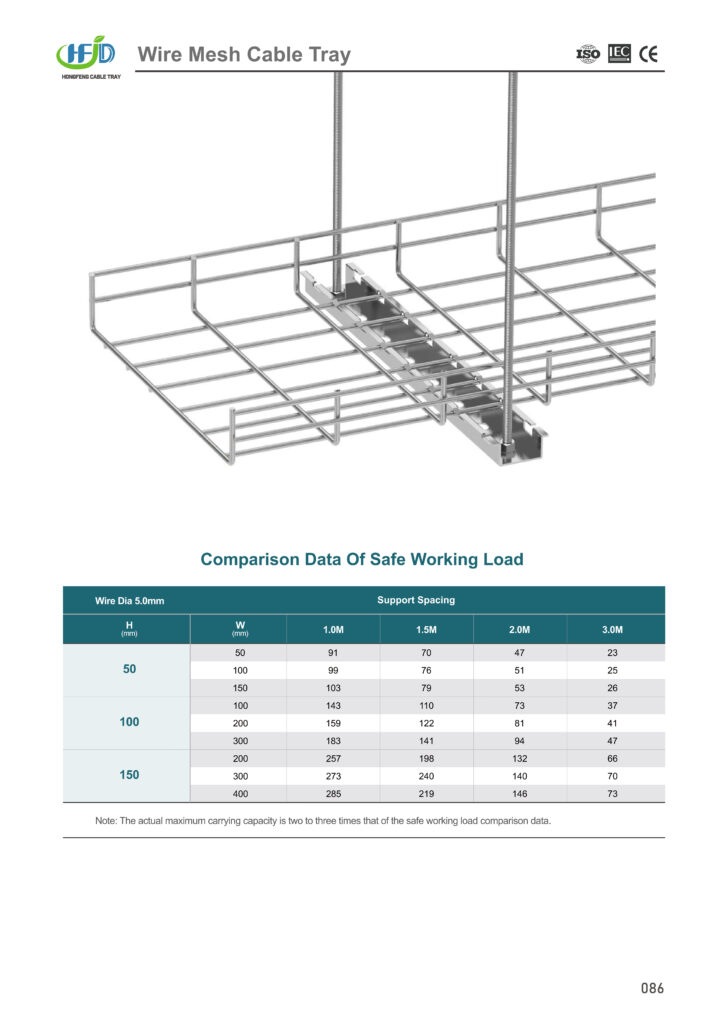
How Much Cable Can a Wire Mesh Cable Tray Hold?
There is no single cable capacity for all wire mesh cable trays.
The actual capacity depends on several factors, including:
- Tray width and height
- Wire diameter
- Material
- Cable type
- Cable quantity
- Cable weight
- Support spacing
- Installation configuration
For example, a tray carrying lightweight data cables will have very different requirements from one carrying multiple large power cables.
For project selection, provide the cable type, cable outside diameter, cable quantity, approximate cable weight, tray dimensions, and support conditions. These details allow the appropriate tray specification to be evaluated.
How Can You Improve Cable Management with a Wire Mesh Tray?
A well-designed cable tray system should not simply provide enough space for cables. It should also make future maintenance and expansion practical.
Keep power and communication cables organized according to project requirements, avoid unnecessary cable congestion, use appropriate accessories at bends and transitions, and provide additional restraint where cable movement could become an issue.
It is also useful to maintain sufficient spare capacity when future expansion is expected.
The goal is a cable route that remains organized, accessible, supportable, and maintainable throughout the service life of the installation.
Why Choose HFJD for Wire Mesh Cable Tray Systems?
HFJD supplies wire mesh cable trays and related cable management accessories for commercial, industrial, electrical, and infrastructure applications.
The product range can include cable trays, couplers, support brackets, dividers, cable fixing clamps, and other installation accessories.
Customers can request:
- Standard tray sizes
- Different materials and finishes
- Customized dimensions
- Compatible accessories
- OEM and ODM production
- Bulk project supply
- Drawing-based customization
For a complete cable management project, providing the cable specifications and installation requirements allows the appropriate tray and accessory configuration to be evaluated together.
FAQ
What is the main purpose of a wire mesh cable tray?
Its main purpose is to support and organize electrical or communication cables along a planned route while providing easy access, visibility, and ventilation.
Is wire mesh cable tray better than ladder cable tray?
Neither is universally better. Wire mesh trays are often advantageous for accessibility, ventilation, and flexible cable routing, while ladder trays may be preferred for certain heavy-duty cable applications. The correct choice depends on the project requirements.
Can wire mesh cable trays be used for power cables?
Yes, provided the selected tray system has sufficient capacity for the cable type, quantity, weight, and installation conditions.
Are wire mesh cable trays suitable for data cables?
Yes. Their open construction provides good accessibility and ventilation, making them suitable for many data and communication cable installations.
Do wire mesh cable trays need cable fixing clamps?
Not every installation requires the same level of cable restraint. Clamps can be useful on vertical runs, bends, equipment connections, and other locations where additional cable positioning is required.
What information should I provide when ordering a wire mesh cable tray?
Provide the cable type, cable diameter, cable quantity, required tray dimensions, installation environment, material preference, and project quantity. Drawings or cable schedules are also helpful for project-specific recommendations.
Final Takeaway
A wire mesh cable tray is a practical cable management solution when a project requires easy access, good ventilation, visible cable routing, and flexibility for installation or future changes.
It is particularly suitable for data centers, commercial buildings, industrial facilities, and many electrical infrastructure applications. However, the right tray depends on cable loading, dimensions, environment, protection requirements, support spacing, and applicable project standards.
If you are selecting a wire mesh cable tray for a new project, do not choose the tray based on width alone. Start with the cable requirements and installation environment, then select the tray, supports, and accessories as a complete system.
Need help selecting a wire mesh cable tray system? Contact HFJD with your cable specifications, project requirements, and expected quantity for a suitable solution.