
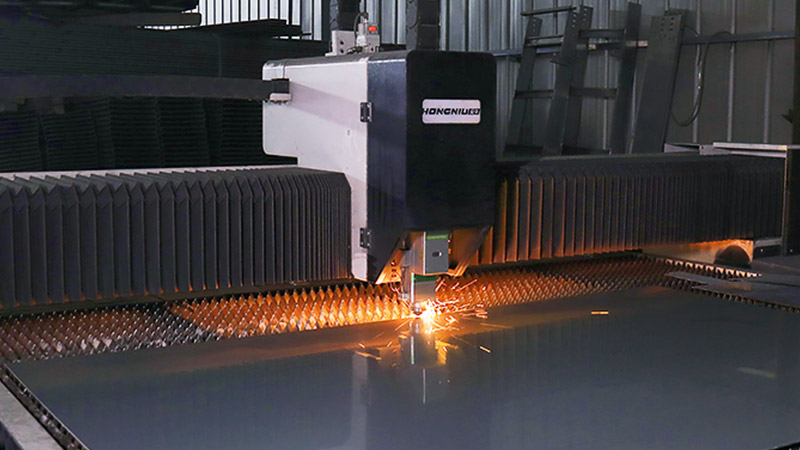
From raw materials to finished products, ensuring structural reliability.
In cable tray manufacturing, quality consistency directly impacts project safety and long-term performance. As cable trays function as load-bearing structural components, any deviation in material strength, coating durability or dimensional accuracy can affect installation stability.
Quality control begins with raw material selection. High-quality galvanized steel, strip steel, stainless steel and aluminum alloy form the structural foundation of cable trays. Stable sourcing channels ensure consistent material thickness, surface condition and mechanical properties.
During production, precision cutting and punching determine structural uniformity. Automated equipment maintains consistent hole spacing and edge alignment, improving installation compatibility. Bending processes must achieve accurate angles and structural symmetry to ensure load-bearing performance.
Welding operations require strong joint integrity and smooth finishing. Weak welds may lead to deformation under heavy cable loads. Standardized welding procedures and inspection checkpoints are therefore critical in preventing structural defects.
Surface treatment significantly influences corrosion resistance. Electrostatic powder coating ensures even coverage and strong adhesion. Controlled curing temperature between 180–220°C allows powder particles to fully melt and bond to the metal surface, forming a dense protective layer.
Final inspection includes dimensional verification, coating thickness testing and structural strength assessment. Proper packaging protects finished products during transportation, minimizing surface damage.
By implementing full-process quality management systems, manufacturers can ensure that each batch meets engineering standards. In large-scale infrastructure projects, such reliability reduces maintenance costs and enhances operational safety.
For enterprises committed to long-term development, quality control is not simply compliance—it is a strategic investment in brand credibility and customer trust.