
Tabla de contenidos
A cold storage cable tray must carry power, lighting, controls, sensors, communications, and refrigeration-system cables through spaces where low temperatures, condensation, washdown, frost, and repeated thermal cycling can occur. The correct design depends on the room classification, temperature range, cable properties, route transitions, cleaning method, support structure, and governing electrical requirements.
Respuesta rápida
Select a cold storage cable tray by mapping freezer, cooler, loading, machine-room, washdown, and ambient zones first. Use tray and cable materials rated for the lowest operating and installation temperatures. Control condensation at warm-to-cold transitions, keep drainage paths open, allow for movement, and choose compatible brackets, fasteners, covers, and bonding components. Do not select the tray from corrosion resistance alone.

Define temperature and operating zones
A frozen warehouse is not one uniform environment. Doorways, evaporators, docks, ceilings, insulated-panel penetrations, battery-charging areas, and compressor rooms produce different exposures. For each cold storage cable tray route, document minimum and maximum temperature, humidity, washdown frequency, defrost cycles, chemical exposure, air movement, and possible mechanical impact.
Cold storage cable tray planning should record whether the facility is continuously cold or periodically warmed for cleaning or maintenance. Rapid changes can create more moisture than a stable low-temperature room. Identify routes beneath evaporators, drain lines, and roof penetrations where leaks or frost may occur. This zone map should guide material, covers, supports, and inspection access.
Control condensation at transitions
Condensation often forms where warm humid air reaches cold surfaces. A cold storage cable tray passing through insulated panels can also create a path for air leakage if the penetration is poorly sealed. Coordinate vapor barriers, insulation, fire stopping, and electrical penetrations so the building envelope remains continuous and maintainable.
For cold storage cable tray, orient solid surfaces so liquid can drain rather than collect. Avoid closed pockets at couplers, supports, and covers. Where covers are required for dripping water or falling ice, provide secure attachment and removal access. Do not wrap the tray in unapproved insulation, because hidden moisture can delay corrosion detection and complicate cable inspection.
Select material and finish as a system
| Material | Potential benefit | Verificaciones antes de la selección |
|---|---|---|
| Acero inoxidable | Corrosion resistance in wet or washdown areas | Grade, chlorides, cleaners, fastener compatibility |
| Acero galvanizado en caliente | Mechanical strength with zinc corrosion protection | Condensation, cut-edge repair, chemicals, coating thickness |
| Acero revestido | Barrier protection and visual identification | Low-temperature coating performance and repair method |
| FRP | Nonmetallic corrosion resistance | Temperature, load, span, impact, fire and smoke requirements |
A cold storage cable tray specification should identify straight sections, fittings, covers, dividers, brackets, bolts, clamps, and bonding parts. Mixed materials can behave differently during thermal cycling and may create localized corrosion when moisture is present. Confirm compatibility with refrigerants, cleaning agents, food residues, salts, and any chemicals used in the room.
For wet or frequently cleaned zones, review the bandeja portacables perforada de acero inoxidable against the actual cleaning chemistry. For less aggressive areas, a galvanized option may be suitable when the exposure assessment and maintenance plan support it. Material names alone do not establish service life.
Choose tray construction around cable duty
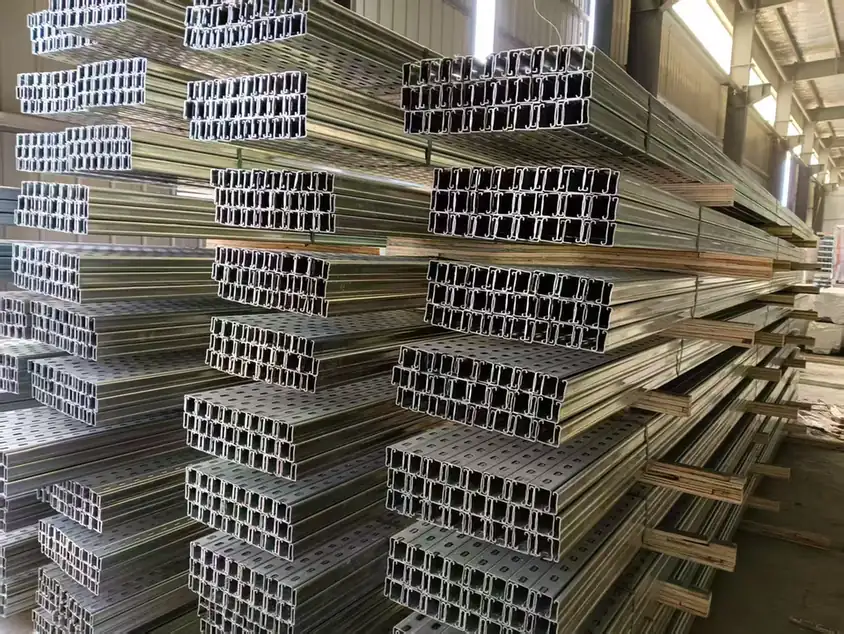
Perforated cold storage cable tray supports smaller control, sensor, and communication cables across a continuous ventilated surface. Ladder tray can suit larger power cables and open routes. Solid-bottom tray adds shielding from localized drips or debris but requires careful drainage and heat review. Wire mesh offers visibility and flexible routing where its load and cable-support characteristics fit.
Cold storage cable tray projects must verify every cable jacket for minimum installation and operating temperature, moisture, cleaning chemicals, oils, flexing, and UV exposure where applicable. Cold cable jackets may be less flexible, so respect bend radius and pulling guidance. Maintain required separation between power, control, communication, and safety circuits using the project’s electrical design.
Plan supports and thermal movement
Calculate cold storage cable tray loading from cables, fittings, covers, dividers, restraints, and future capacity. Support spacing must use verified manufacturer data for the selected tray, orientation, and load. The IEC 61537:2023 cable tray and cable ladder standard specifies requirements and tests for these support systems.
Cold storage cable tray temperature differences between ambient and freezer zones can move long metal runs. Coordinate expansion joints, cable slack, couplers, and supports with the manufacturer’s instructions and structural design. Do not attach a cold storage cable tray to insulated panels unless the approved panel-support system is designed for the load. Avoid compressing insulation or damaging vapor barriers.
Comprobaciones de instalación y traspaso
Protect each cold storage cable tray before installation by following a documented cable tray storage and handling plan. Keep components dry, identified, supported, and clear of damaging site traffic.
- Confirm tray, cable, and accessory temperature ratings.
- Verify supports, anchors, spans, couplers, and fitting supports.
- Check vapor-barrier, insulation, and fire-stopping details at penetrations.
- Remove sharp edges and repair damaged finishes using approved procedures.
- Maintain bend radius, separation, drainage, and access.
- Conexión y puesta a tierra completa según el diseño eléctrico.
- Record field changes and photograph concealed transitions.
Before energization, inspect the entire cold storage cable tray route for deformation, coating damage, loose hardware, trapped water, blocked drainage, cable jacket damage, and unsealed penetrations. The Requisitos de los métodos de cableado de OSHA provide a workplace regulatory reference for covered US installations, while the project code and authority having jurisdiction remain decisive.
Build an inspection plan around operating cycles
Inspect a cold storage cable tray after commissioning and through both cold and defrost conditions. Look for condensation, frost, corrosion, loose supports, failed seals, damaged covers, cable movement, and blocked access. Doorways and warm-to-cold transitions usually deserve closer observation than stable interior zones.
Review cold storage cable tray after washdown, defrost failure, refrigerant work, roof leaks, impact, or major cable additions, perform a targeted review. Correct the source of recurring moisture rather than repeatedly cleaning or coating the visible damage. Update drawings and inventory whenever routes or circuit groups change.
Preguntas frecuentes
Which tray material is best for freezers?
No single material fits every freezer. Select from temperature, condensation, chemicals, washdown, load, impact, fire, and maintenance requirements.
Does cold storage cable tray need a cover?
Only where a defined hazard supports one. Covers must be evaluated for drainage, frost, heat, attachment, removal, and inspection access.
Can standard cables be installed in a freezer?
Use cables whose manufacturer ratings cover the minimum installation and operating temperature plus moisture, chemical, and mechanical exposure.
¿cómo se determina el espaciado de soporte?
Use actual loads, tray material, mounting orientation, fittings, temperature conditions, structural design, and verified manufacturer load data.
What should a supplier inquiry include?
Provide temperature ranges, humidity, washdown, chemicals, cable loads, tray dimensions, route drawings, supports, covers, and applicable standards.
Prepare una especificación específica de zona
A reliable cold storage cable tray design connects temperature data, condensation control, cable ratings, material compatibility, structural support, penetrations, drainage, and maintenance. Send the zone schedule with cable lists and route drawings so suppliers and installers can review the complete system rather than isolated tray sections.